Hooked-apophysis Artoria Artoria hamifera Prado, Baptista & Framenau, 2026
Fauna Portal species: 12484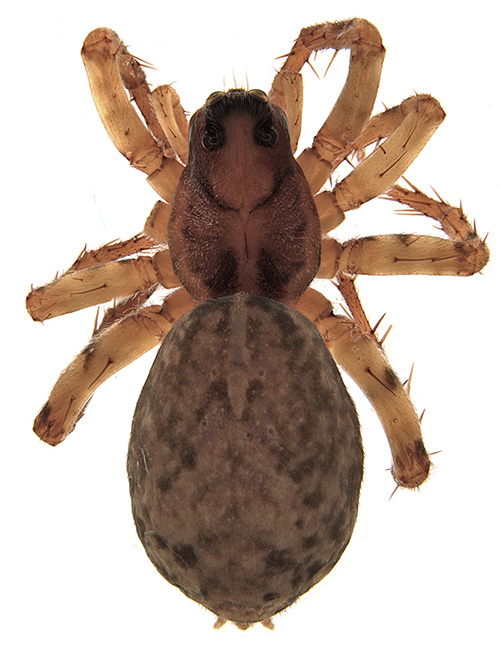
Artoria hamifera female, dorsal habitus (QM S58231; Lake Eacham, Queensland)
Image: Prado, Baptista & Framenau (2026; fig. 18A)
Fauna Portal Image No. 14718Diagnosis
Males and females of Artoria hamifera are similar to those of A. helensmithae Framenau & Baehr, 2018, A. beaury Framenau & Baehr, 2018, A. mungo Framenau & Baehr, 2018, A. geniculata and A. semicircularis. The tegular apophysis of males of these species are similar, bearing a broad apex with rounded prolateral apical corner and its retrolateral portion curved and projected ventrally ending in an acute or rounded tip. However, males of A. hamifera are distinguished from these species by a very small and poorly sclerotized terminal apophysis. In addition, they can be distinguished from those of A. beaury, A. semicircularis and A. helensmithae by a much shorter and broader embolus. In relation to A. mungo, they have a broader basoembolic apophysis and by the prolateral margin of the apex of the tegular apophysis slightly curved ventrally and not strongly projected ventrally and curved retrolaterally as in A. mungo. Females of A. hamifera, A. helensmithae, A. beaury, A. mungo share an epigyne with rounded and broad median septum and broad lateral lobes; however, A. hamifera differs from A. mungo by having a longer than wide median septum and inconspicuous anterior margin of the atrium, while A. mungo has wider than long median septum and a well-marked anterior margin of the atrium. Compared to A. helensmithae and A. beaury that have an epigyne with posterior tips projecting mesally from the semicircular lateral lobes, A. hamifera have subrectangular lateral lobes without projecting posterior tips.
Linnean Holotype
Australia
- New South Wales
- Queensland
Fauna Portal Records
The map shows all records that have been verified as part of the Fauna Portal project and may not represent the true distribution of a species. Specifically, for described species, check the link to the Atlas of Living Australia on this page for potential wider distributions. Fauna Portal Reference specimens and Linnean types are shown in red. If you identified a specimen that exceeds the distribution of an undescribed species as illustrated here, please contact the Fauna Portal team who can assist with the lodgement of the specimen in a public institution and display on the map.
Similar Species
Publications
(2026): Taxonomic revision of the wolf spider genus Artoria (Araneae, Lycosidae, Artoriinae) from Northern Territory and Queensland, with additions to the fauna of New South Wales and the Australian Capital Territory. Megataxa. 19: 379 - 456DOI