Confusing Wolf Spider Kochosa confusa Framenau, Castanheira & Yoo, 2023
Fauna Portal species: 10983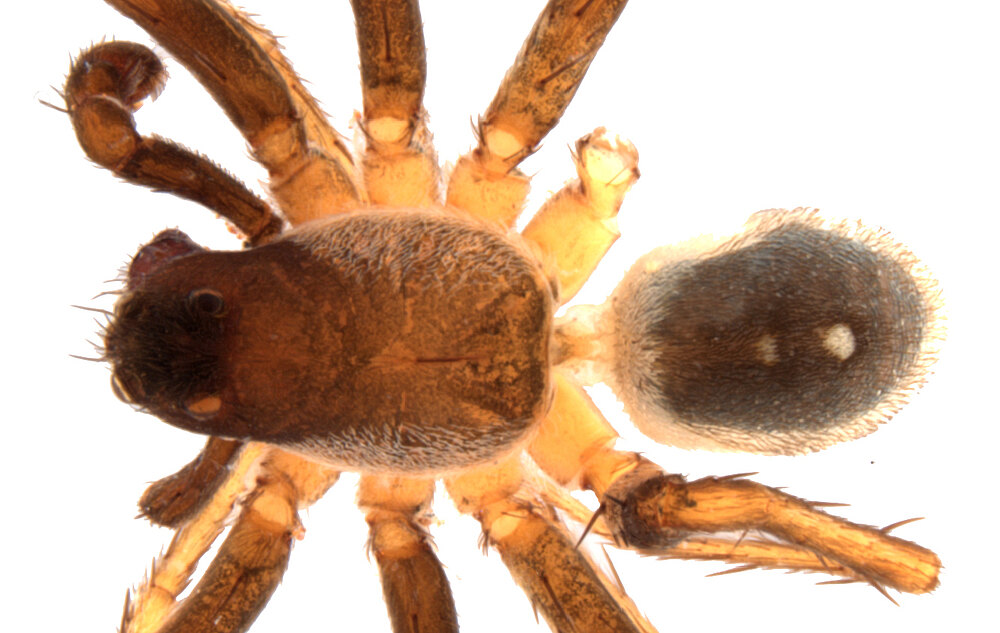
Kochosa confusa male, dorsal (QM S44298; Isla Gorge Lookout, Queensland)
Image: Framenau et al. (2023; fig. 10A)
Fauna Portal Image No. 942Diagnosis
(after Framenau et al. 2023): Males of K. confusa are most similar to K. australia, K. erratum and K. mendum due to the arching base of the embolus. Kochosa confusa can be differentiated from K. australia and K. mendum by the shape of the sperm duct visible through the tegulum, which forms a closed loop in K. confusa (and K. erratum), but an open arch in the latter two. Male K. confusa differ from K. erratum by details in the embolic division of the pedipalp bulb, specifically the less curved embolus and the lack of a sclerotised retrolateral edge. Females of K. confusa are most similar to those of K. nigra, based on the shape of the median septum of the epigyne forming a raised triangle; however, this triangle is medially closed in K. confusa, but not so in K. nigra.
Linnean Holotype
Australia
- Queensland
Fauna Portal Records
The map shows all records that have been verified as part of the Fauna Portal project and may not represent the true distribution of a species. Specifically, for described species, check the link to the Atlas of Living Australia on this page for potential wider distributions. Fauna Portal Reference specimens and Linnean types are shown in red. If you identified a specimen that exceeds the distribution of an undescribed species as illustrated here, please contact the Fauna Portal team who can assist with the lodgement of the specimen in a public institution and display on the map.
Similar Species
Publications
(2023): The artoriine wolf spiders of Australia: the new genus Kochosa and a key to genera (Araneae: Lycosidae). Zootaxa. 5239: 301 - 357DOI