House Spitting Spider Scytodes univittata Simon, 1882
Fauna Portal species: 4333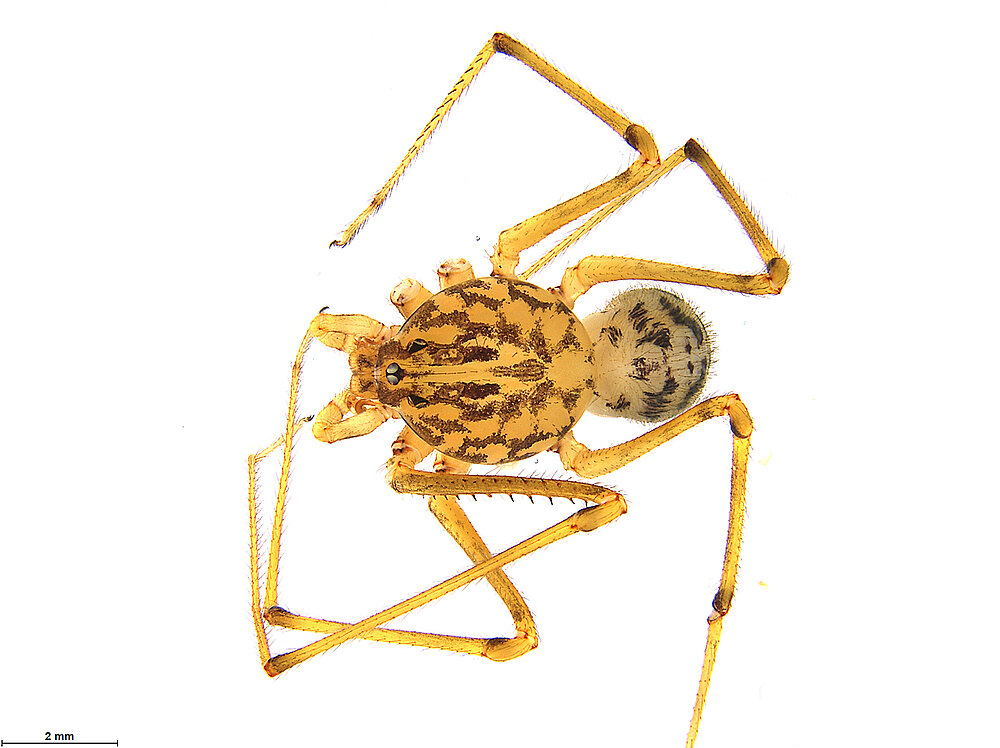
Scytodes univittata male, dorsal (HBI N19712-1; Wembley, Western Australia)
Image: V.W. Framenau (2024)
Fauna Portal Image No. 9192Diagnosis
(after Brescovit & Rheims 2000): Scytodes univittata is distinguished from other species of Scytodes by the male femur I, with a double row
of strong spines, by the long, slender embolus with a sclerotised, sinuous basal projection and by the female genitalia with v-shaped foveae and curved, deep positioning ridges.
Scytodes univittata appears to be the most common synanthropic spitting spider in Australia but has often been misidentified as S. thoracica. However, online image depositories (i.e. iNaturalist) appear to also show S. thoracica to be present in Australia, particularly in the south-eastern parts of the country. The carapace pattern is very different between the two species with S. thoracica lacking the central, elongated, tear-drop shaped dark mark.
Status
- introduced
Linnean Type
Holotype female, Tes ("about 30 km off the coast and about 35 km west of Aden"), Yemen, R. Manzoni (likely in Museum national d'Histoire naturelle, Paris)
Australia
- South Australia
- Western Australia
Fauna Portal Records
The map shows all records that have been verified as part of the Fauna Portal project and may not represent the true distribution of a species. Specifically, for described species, check the link to the Atlas of Living Australia on this page for potential wider distributions. Fauna Portal Reference specimens and Linnean types are shown in red. If you identified a specimen that exceeds the distribution of an undescribed species as illustrated here, please contact the Fauna Portal team who can assist with the lodgement of the specimen in a public institution and display on the map.
Publications
(2000): On the synanthropic species of the genus Scytodes Latreille (Araneae, Scytodidae) of Brazil, with synonymies and records of these species in other Neotropical countries. Bulletin of the British arachnological Society. 11: 320 - 330