Pale Leaf-curling Spider Phonognatha melania (L. Koch, 1871)
Fauna Portal species: 3475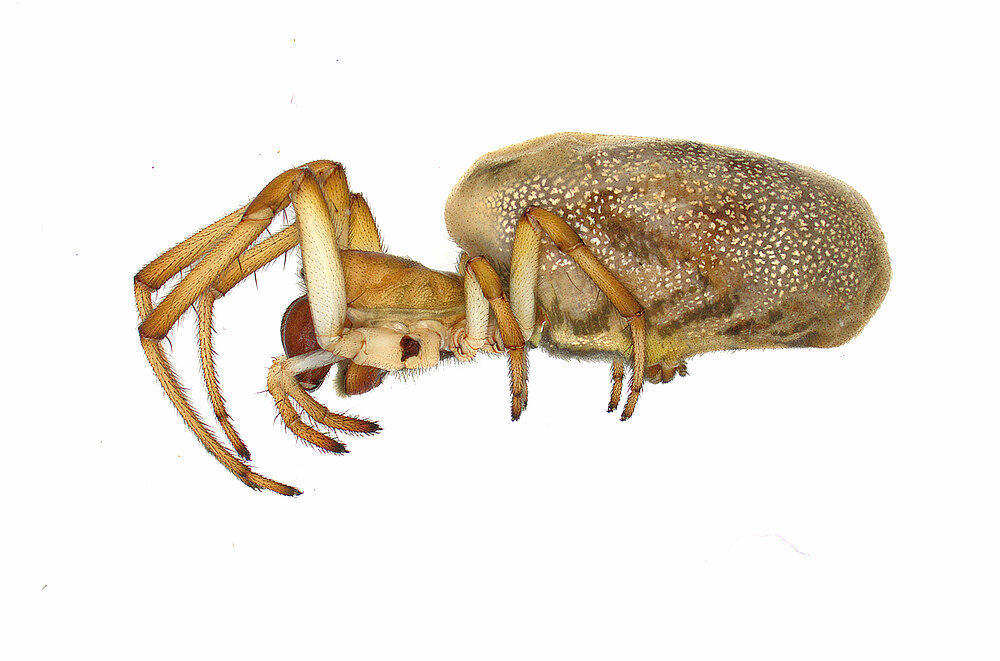
Phonognatha melania female, lateral (HBI N38179-1; Stirling Range Retreat, Western Australia)
Image: V.W. Framenau (2026)
Fauna Portal Image No. 13846Diagnosis
(after Kallal & Hormiga 2018): Males of P. melania can be distinguished from congeners based on their pedipalp tibiae, which are slightly longer than (up to 1.5 times) the length of the palpal cymbium, and broader midconductor process. Other Phonognatha have pedipalp tibiae shorter than the cymbium except for P. tanyodon, which has a tibiae many times longer than the cymbium. The females have an elongated abdomen of relatively equal width for the length of it, with two dark markings on the dorsal area and spinnerets positioned centrally on the venter. The abdomen of Artifex species are somewhat elongated but with a crescent- or ring-shaped dorsal pattern and wide, solidly dark posterior.
Status
- native
Linnean Syntype(s)
Australia
- Australian Capital Territory
- New South Wales
- Queensland
- South Australia
- Tasmania
- Victoria
- Western Australia
Fauna Portal Records
The map shows all records that have been verified as part of the Fauna Portal project and may not represent the true distribution of a species. Specifically, for described species, check the link to the Atlas of Living Australia on this page for potential wider distributions. Fauna Portal Reference specimens and Linnean types are shown in red. If you identified a specimen that exceeds the distribution of an undescribed species as illustrated here, please contact the Fauna Portal team who can assist with the lodgement of the specimen in a public institution and display on the map.
Publications
(2018): Systematics, phylogeny and biogeography of the Australasian leaf-curling orb-weaving spiders (Araneae: Araneidae: Zygiellinae), with a comparative analysis of retreat evolution. Zoological Journal of the Linnean Society. 184: 1055 - 1141