White Heckle-mesh Spider Callevophthalmus albus (Keyserling, 1890)
Fauna Portal species: 7072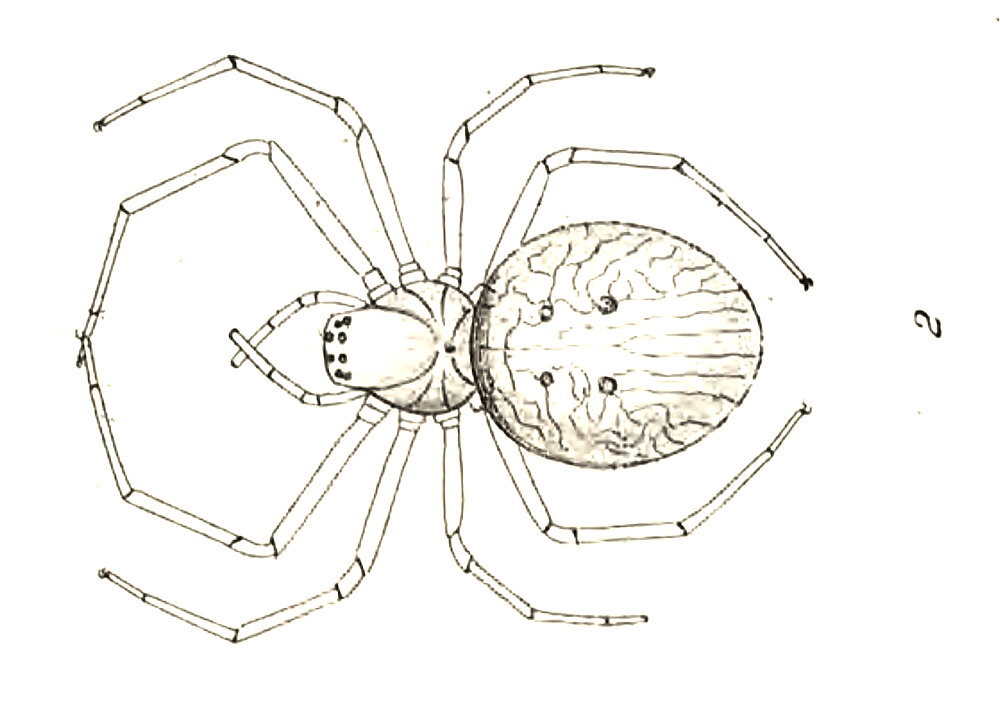
Callevophthalmus albus female, dorsal
Image: Keyserling (1890; pl. 23, fig. 2)
Fauna Portal Image No. 4576Diagnosis
Male Callevophthalmus albidus are very similar to Callevophthalmus FP-15103 with both species having a much longer and stronger basal pedipalp conductor. Callevophthalmus albus differs from Callevophthalmus FP-15103 by the direction of the dorsal tibial apophysis that is much closer to the pedipalp cymbium (in lateral view).
Callevophthalmus lividus described from Western Australia was synonymised with C. albus by Lehtinen (1967), but taking the diversity of the genus in Western Australia to account, where at least three very similar species occur, this synonym should be tested by examining a broader range of specimens throughout Australia, including the types of the species.
Status
- native
Linnean Syntype(s)
Australia
- New South Wales
- Norfolk and Lord Howe Islands
- Tasmania
- Western Australia
Fauna Portal Records
The map shows all records that have been verified as part of the Fauna Portal project and may not represent the true distribution of a species. Specifically, for described species, check the link to the Atlas of Living Australia on this page for potential wider distributions. Fauna Portal Reference specimens and Linnean types are shown in red. If you identified a specimen that exceeds the distribution of an undescribed species as illustrated here, please contact the Fauna Portal team who can assist with the lodgement of the specimen in a public institution and display on the map.
Publications
(1967): Classification of the cribellate spiders and some allied families, with notes on the evolution of the suborder Araneomorpha. Annales Zoologici Fennici. 4: 199 - 468